Showing posts with label business. Show all posts

Friday, 23 September 2016

Five Tips for SEO

Every year, search engine optimization seems to change in some ways. Here are five helpful tips for you to keep track of how to best optimize your content in 2014:

1) Don’t slack off on your company’s social media presence

Although social media sites like Facebook, Twitter, LinkedIn and Google+ have been around for years now, that doesn’t mean they are irrelevant. If anything, your business needs to have a strong social media strategy now more than ever to help build awareness for your brand and to drive web traffic.

Also, remember people want to share relevant, quality content that relates to your audience’s lives in some way—don’t just create things for the sake of sharing. SEO optimization for your website isn’t just about creating and sharing content—it’s about creating and sharing content that people will care about.

2) Keep your writing natural

In the past, Google may have been more likely to pick up word-for-word keywords. Now, though, with the introduction of Google’s latest search algorithm Hummingbird, natural writing is taking center stage. This ties back to your company having strong content that drives traffic. Instead of focusing on writing around a keyword, make your keywords flow more naturally—if a few words are separating a keyword phrase, that will be OK. Google now recognizes ideas more so than just words, allowing your writing to really shine.

3) Don’t forget about local search optimization

Local content and search engine indexing will not be slowing down this year. More and more, Google is localizing search results to better cater to users’ needs. Look more into Google+ Local to see just how powerful localized results can be. In fact, the more you can use localized long-tail keywords and build out your local listing profiles, the better.

4) Keep your sites responsive

In the past, web and mobile sites largely lived in separate worlds—sites looked and performed completely differently on mobile devices and desktops. Now, though, if a company wants to not only look fresh but be indexed well in search engines, it should create a responsive site that can be viewed on all of today’s modern devices: smartphones, tablets, laptops and desktop computers. This not only creates happier users because they get a consistent, functional website, but it can also increase your search engine visibility and shares on social media.

5) Establish yourself as an expert

Whatever your business’s focus is, you’ll want to come off to your clients as an authoritative voice in your field of expertise. To do this, continue to create content for your blog, but make sure you can provide your viewers with helpful information. When you can provide practical tips for your readers, your website will be more valuable, as will your search engine optimization. Your viewers will begin to trust your voice more on important industry issues, and you can become their one-stop shop for important information.

Wednesday, 10 August 2016

Simple is Better: How to Talk to Your Clients about SEO

As a professional internet marketer, you already know all about the benefits of SEO. In fact, the idea of creating a website without implementing SEO techniques probably seems ridiculous. But outside the internet marketing realm, the benefits of SEO are not always so well understood. 
If a client simply “wants a website” they may need a little convincing to purchase your SEO expertise. On one hand, you don’t want to be in a position where it simply seems like you’re trying to push services on your client. On the other hand, a client is rarely going to be happy with the results they’ll get from a website which hasn’t been optimized for search engines.
Here are a few tips and tricks to help your clients understand the benefits of Search Engine Optimization:
Don’t Be Overly Technical
“First, I’m going to create natural backlinks. Then I’ll insert keywords with a localized approach. Finally, I’m going to devote about 50% of my time to your mobile presence.”
Sure, this isn’t overly complicated to an SEO pro, but for a client unfamiliar with this world the above sounds like a bunch of buzzwords. So you want to use clear, plain explanations. Don’t focus so much on what you’re going to do. Focus on the benefits which the client will experience directly.
This boils down to three reasons to implement SEO. These are concepts any client can appreciate:
Reason #1: SEO is Customer Friendly
In order to explain the importance of SEO to a client, you’ll want to bring up your favorite analytics tool. Show your client where their traffic, conversions and sales originate. For the most part, organic searches are going to drive most of this.
Without SEO, your client’s organic results are basically, well, subject to the fates. SEO gives your client’s site more control over their SERP. (Of course, you’ll want to explain this without using all the acronyms.)
With SEO, your client’s SERP will raise. This means more potential customers will find your client when they search for terms related to the product or service they provide. This increased exposure usually leads to more sales.
Here’s a simple way to explain this to your clients:
Without SEO, your business will still show up in the search results. But you really have no say as to where in those search results your business will appear. It’s not likely to be in a top spot, however, simply because your competitors are already using SEO to take those top spots. Without SEO, your business will stagnate.
With SEO, your ranking in the search results is more controllable. Even better, SEO techniques can continually improve your ranking over time. More and more customers will be drawn to your site when they search for terms related to your business. With SEO, your business will grow.
Reason #2: SEO is Cost Effective
I’ve had my fair share of clients who believe the most effective way to find success online is to simply spend money. I’ve also had plenty of clients who had a limited budget. Fortunately, SEO works well in both situations.
If your client insists on buying something, you can direct them to pay-per-click strategies, banner ads and the like. But you’ll also want to tell them that some of their best results will come from simple, free SEO solutions. Obviously, they’ll still have to pay you, the SEO pro, to implement these strategies – but that’s still cheaper than paying you to implement paid strategies.
SEO allows you to attract high quality traffic. SEO can even level the playing field between large and small companies. Smart SEO strategies can push a small business to the top of the search results page.
How do companies use SEO so effectively? They approach the concept from the very start of development. SEO strategies are integrated into every aspect of their online presence. This includes content marketing, social marketing and any other aspect of their brand.
This approach doesn’t care how much money you spend. The strategies alone make the difference. This makes SEO not only the most cost effective technique but also simply the most effective all-around.  
Reason #3: SEO is Long-Lasting
The advertising and marketing budget of a business can change quickly. If the company is reliant on paid ads, their entire strategy can be in trouble if the budget shrinks. This isn’t the case with SEO.
SEO never stops working. In fact, many SEO practices become more effective the longer they exist. Each year, you can add more to your SEO strategies – more keywords, more guest blogs and so on. Eventually, your client can own their niche and dominate their market.
Paid strategies can stop and start depending on your client’s needs and budget. As long as you have effective SEO strategies in place, potential customers will still be driven to your client’s site. This lets you implement paid strategies only at key times, such as during specific holidays.
Your Clients Want SEO…
…even if they don’t know it yet. Convincing them can sometimes be difficult. After all, SEO isn’t a physical thing you can see the way you can see a banner ad. Sometimes I’ve had clients who didn’t understand how important just a few keywords can be.
But most businesses respond to the bottom line. When you use these three strategies above, you’ll be able to explain to your clients how SEO can increase their profits in the long run. In fact, SEO is one of the most cost effective ways a business can grow online.
You might also explain how creating a website without SEO is basically a complete waste of time. A website people can’t find isn’t really a website at all. So even though convincing a client they need SEO isn’t always the most fun activity, it is a necessity. Hopefully the above strategies will lead to smooth communication and a long-term relationship with a great (and now knowledgeable) client.        

The Truth is Out There: 4 Google Conspiracy Theories Explained

As an SEO pro, you probably already know that search engines can sometimes behave… in mysterious ways. Part of our job as internet marketers is pretty straight-forward: researching keywords, publishing content and creating natural backlinks.
Another part of our job is a little more theoretical. We need to predict where organic search trends are heading. The better we can predict the unknown, the more effective we’ll be at spotting both opportunities and potential problems within a client’s campaign.
Google’s algorithms are notoriously secretive. We basically have to use inductive reasoning to figure out what will help site rankings, revenue and traffic. Dealing with so many unknowns seems to have made more than a few SEO experts a bit, shall we say, conspiracy-minded.
Today we’re going to take a look at some of the more far-fetched theories. Are they totally crazy, or is there something to them after all?
Conspiracy Theory #1: Google Wants to Decide What’s True
We’ll start with one of the more popular “world domination” related theories. Google wants to decide what a true fact is and isn’t. This means accuracy is used as a ranking factor, with Google determining what’s accurate about any given subject.
This theory can be traced to back a Washington Post article titled, “The Huge Implications of Google’s Idea to Rank Sites Based on Their Accuracy.” Basically, Google published a paper discussing a plan to identify the overall level of factual accurateness of a web site. Site with more factual information would rank higher than sites deemed less accurate.
Google doesn’t deny this. But the plan isn’t really what it seems. “This was research,” Google told the Post. “We don’t have any specific plans to implement it in our products. We publish hundreds of research papers every year.”
The problems are very theoretical but, admittedly, pretty scary. An example would be: What if Google Decided the Earth was flat? Every top search result related to the Earth would promote this Flat Earth theory.
While that example is a bit over-the-top, we understand why people aren’t thrilled with this idea. But the good news is this is a completely speculative idea at this point. It’ll be a long time, if ever, before Google will be able to implement such a plan into action.
We Say: Not a conspiracy yet, but could maybe possibly be one in the future.
Conspiracy Theory #2: Organic Rankings are being De-Prioritized
The origin of this theory is pretty obvious. Google doesn’t profit from organic results. They do profit from selling AdWords, however. If they deprioritize organic results, more and more companies will choose paid listings.
We hate to say it, but there might actually be something to this. The more we talk to other SEO pros, the more we find people who say they’ve never (or rarely) seen an organic listing “above the fold” in mobile listings. With desktop results, we also can’t help but notice how local listings are usually prominent in the top screen view of search results.
To be clear, we’re not suggesting this is an intentional ploy by Google to de-prioritize organic results. After all, all the evidence we have is anecdotal. That’s hardly enough to justify the label of “conspiracy theory.”
The best way to work with this theory is compare your organic results to the paid results of your competitors. If you’re getting buried beneath paid listings, you might want to either buy some listings yourself or find new keywords to insert into your content.
We Say: Probably not an evil conspiracy, but definitely something to pay attention to.
Conspiracy Theory #3: Buying AdWords Improves Your Organic Rankings
This one is an oldie but a goodie. Does Google reward sites who purchase AdWords with an increase in that site’s organic search result ranking?
What do we think? There’s simply no evidence that buying AdWords will boost your organic search results rankings. Google isn’t favoring customers who purchase AdWords in any artificial way.
Even if they did, why would they keep it a secret? Acknowledging that organic search results can be directly improved simply purchasing AdWords would probably cause sales of AdWords to go through the virtual roof.
But like any good conspiracy theory, there is some truth behind the idea. Mainly, AdWords does lead to some organic benefits. These benefits are:
·         Users are more likely to spend money when you have both organic and paid listings. These two listings together expose your brand to the widest possible audience.
·         Paid ads lead to more searches for your brand later on. If people don’t pay much attention to your ad at the time, they’re still likely to remember your brand later.
·         Paid ads can increase your incoming links. This, in turn, will improve your organic search results.
We Say: Not an organized conspiracy, but paid listings should be considered for any SEO campaign.
Conspiracy Theory #4: The U.S. Government has a Backdoor into Google
We can’t really discuss conspiracy theories unless we throw in one which involves the government. The theory here is that the CIA, FBI and other agencies has immediate and unrestricted access to Google through a backdoor.
With Edward Snowden and the revelations of the PRISM surveillance program, this idea is far more plausible than it would’ve been just five years ago. But is there an actual backdoor into Google?
They say – very clearly – no, there isn’t. They published a response which read, in part, “The U.S. government does not have direct access or a ‘back door’ to the information stored in our data centers.”
That’s likely all there is to the issue of a backdoor. But this doesn’t meaning using Google makes you anonymous. Everything you do on Google has the potential to be acquired by the government through a request.
We Say: Unfounded conspiracy, but don’t think your internet activity is completely free from government access.
Conclusion
Most of these “conspiracies” have an element of truth. But that truth usually has a pretty innocent explanation. So, you can probably keep your tin-foil hat on the shelf for now. The good news is that all of these theories are pretty creative. The best way to learn more about how Google operates is to formulate a theory and then test it out. So keep those conspiracy theories coming – even the craziest ideas might have some worthwhile information.  

Wednesday, 20 July 2016

Tips and Tricks to get you started with Social Media Marketing

Just when you’ve decided to build your social media presence, you face the dilemma “where do I begin”. You have so many platforms, so many users to connect with, a plethora of content you can explore from various angles!
You should know that there is no one-size-fits-all strategy for social media marketing. It all depends on the nature of your business, the products and services you offer, the audience you want to target, your budget and so on. It takes some time to learn what works for you and what doesn’t.
Having said that, let’s begin with the tips that can get you started.

Know the various social media channels

These are the places which can get you the right audience for your business. So a deeper understanding of these platforms can help you get the edge over your competitors. Start with the Big Four – Facebook, Twitter, LinkedIn, and Google+.
It’s safe to start with one or two of the platforms rather than jumping on all 4 channels at once. Many marketers have tried this and failed miserably.
A simple way to find a suitable platform for your business is to follow the influencers in your niche. Analyze them closely and check their followers on Facebook, Twitter, Google+, Pinterest and so on.
Survey your customers or clients to find out which platform they use and prefer the most.
Another way is to find the leading business in your niche and visit their social media profiles. Let’s say they have 10,000 followers on twitter and 1000 fans on facebook. This is a strong sign that twitter is a better platform for your business. But don’t stop there. Drill down to find their engagement level on these platforms. This will help you determine which one can produce better results.

Optimize your Profiles

Once you decide which platform you want to target, the second step is to optimize your profile. This is going to help you with your SEO and will also increase your followers/fans.
  • Update your profile and cover image
Use high-quality images which represent your business and your logo. Social media is all about connecting with people. Your profile picture will create the first impression of your business.
  • Keep your description catchy.
Your description should capture your expertise and Unique Selling Proposal. Try to keep it short. When you are writing your Twitter bio besides your main keywords, add relevant hashtags.
  • Include a link to your website.
Including a link will help your SEO. You can add it to the “About me” section of Facebook,“Website section” of Twitter and “Contributor section” of Google+.
  • Add your physical address and phone number.

Build Your Audience

tips on building an audience
Once you have set up your profile there are a few basic steps which you can take to build your audience. First, you can invite your friends, clients, partners, and employees to the page.
Make your Social Media Buttons omnipresent. Add social media widgets to your blog or website and social media buttons to your email signature. You should always link your social media accounts on your “About us”, “Contact Us” page, blogs, newsletter etc.  
Also, incorporate social media buttons to your website so when you add content to your blog, for example, readers can easily share it. There are various plugins which can help you do that. Always, make these buttons large in size so that they are easily visible and clickable.
Once you have connected with your current contacts try reaching a new audience. Target people with interests in your niche and potentially your product or service. Run social media ads which target the right audience for your business.
Now, let’s have a look at each platform and check some specific strategies:
Facebook:
  • Advertise – target under 50,000 people. Retarget your ads for people who have visited your blog/website once. Choose your “type of ad” based on your audience, budget, and product/service. 
Twitter:
  • Start following relevant accounts – mostly users follow you back when you follow them. So it can make a good strategy for those who are just starting on Twitter. Go through the list of followers of other influencers in your niche. Optimize this list and start following relevant users.
  • Use trending and relevant hashtags
  • Find interesting twitter chats to join. Contribute to the conversation and interact with other participants. People will follow you when they see your expertise and the interesting insights you have.
Google+:
  • Get involved in Google+ circles – find circles which are relevant to your niche, follow them and build a community.
  • Join and contribute value to relevant communities.
LinkedIn:
  • Ask all your employees to get involved
  • Always customize your invitation requests
Don’t rush into building your followers. If you are not already aware, let me tell you that twitter restricts the number of people you can follow per day. Also, on Google+ you can add/delete only a number of people from your circle.
Rome wasn’t built in a day and the same goes for your social presence. You need to have some patience to build thousands of followers. Do not rush into it at the cost of breaking the rules. You might end up getting your account suspended.
I would suggest you build real followers. Then, concentrate on creating amazing content that people would love. This will not only help your SEO efforts but will also help you become an authority in your niche.

Share content that people will love

Share content that people will love
Content will remain king forever, and I always say interactive content is the hand of the king. The same goes for social media. When you publish interesting, unique and eye-catching content, people are bound to share it. The more people share it, the more visitors and followers you get.
But what do you post? I have compiled a list of interesting content that you can publish:
  • News posts and articles which focus on a controversial topic in your niche.
  • Customize quotes to your niche. (I would recommend using Canva for those)
  • Posting about any new research or stats in your area (of course by giving proper citations). Alternatively, make your own research and present your findings.
  • Create your own infographics – or if you are using someone else’s, make sure you mention them
  • Post videos – a “how-to” video tutorial is a good option to start with.
  • Use memes, GIFs and other trends. Share a joke once in awhile.
  • Include relevant hashtags. They make your content more searchable.
If you are not able to achieve the right amount of engagement in the form of likes, shares or comments, then you need to change your strategy.
One tested way to boost the engagement levels is adding images to your posts. Images catch the attention of your followers easily and help them comprehend the content better.  Your message becomes more clear and memorable.
You can look for blank images and customize them (include text in them). For example. you can ask a question and let your followers answer in the comments.
be social and engaging

Post Consistently but don’t go crazy

Just because you got a million likes on your previous post does not mean that your task is done. You need to post consistently but don’t go overboard with it. Create a schedule and allocate specific time to social media marketing daily.
You can also make use of scheduling apps like Hootsuite and Buffer or use an editorial calendar. This will ensure you are not skipping posts and spending more than the required time.
Now, the question is how much should you post on each social media platform daily?
For Facebook, try once or twice in a day. For twitter, the more you tweet, the more exposure your business gets. For LinkedIn, try once in a day (avoid weekends). For Google+, I would suggest you post twice a day.

Social Media Strategies for Each Platform

Each social media network has a different set of users. Therefore, you need a different strategy for each platform. What works for Twitter might not work for LinkedIn.
For example, Facebook has a more diverse user base. Therefore, it can be used to promote any kind of brand. LinkedIn is a great platform for B2B companies. They can use it to promote business related content to corporate influencers.
Spend some time researching what people are looking for on various social networks. Then, align your strategies with these channels.
Now let’s dig into strategies that you could use for the major players:
Facebook:
  • Post Videos. According to TechCrunch, Facebook gets 3 billion views per day.
  • Use High-definition images.
  • Come up with posts that capture the mood of the season or a holiday
  • Change your cover to promote an event
  • Keep your post brief and interesting
  • Post Questions – it’s one of the best ways to strike a conversation (For example, “Which burger do you like the most? Bomb or Devi’s’?
  • Add call-to-actions
Twitter:
  • Optimize your bio – include a link to your website, tell people exactly what you do and how you can help them. Be precise.
  • Use the advanced search feature to search by keywords and find your ideal potential customers.  Go through their profiles and try to learn more about them. Then, customize your content when you are engaging with your target customers.
  • Incorporate images in your twitter posts – tweets with images 313% more engagement.
  • Engage with your followers on a regular basis – retweet and reply to their tweets.
  • Find experts in your niche and interact with them often.
  • Tweet regularly.
  • Use relevant and trending hashtags
LinkedIn:
  • Pick a niche (topic) that connects to your business and keep posting consistent and interesting content.
  • Come up with great headlines – this element creates the first impression of your business.
  • Use Rich media to effectively convey your expertise to your prospects. (videos, slideshare presentations and other interactive tools).
  • Plan your publishing times in a way that gives your posts maximum exposure.
  • You can go for a sponsored ad if your budget permits.
Google+:
  • Make sure you have claimed authorship with your personal Google+ page.
  • Link your website with your Google+ page. Incorporate a Google+ badge on your website, this will enable your users to follow your business on Google+ without  having to leave your website.
  • Try to use hashtags with every post, this will give you an added exposure. But make sure that the hashtag you are using is in sync with your topic.
  • Use clear and illustrative cover photos. You can use this picture to display your new products or advertise any upcoming event.
  • If you find webinars expensive, you can host Google+ hangouts. Although it supports only 10 active participants, you can stream it online to unlimited viewers through youtube.
  • Join communities in your niche. If you can’t find one, you can create your own using your personal profile page.
Instagram:
  • Optimize your profile – include a link, have a consistent name and an eye-catching bio.
  • Use a mix of short videos, graphics, images to know what type of content people react to the most
  • Comment on other people’s content – use industry-related and brand-related hashtags
  • Use fun images from your business – your office or your employees
  • Follow your followers and also, reward them sometimes
  • Keep a flexible posting schedule – use trending hashtags
  • Carefully choose your filters
  • Hold photo contests
Pinterest:
  • Make a business page (and not a profile). Thus, you can get access to analytics and advertising features which is not possible on a Pinterest profile.
  • Take some time out and comment on other pins – relevant pins in your niche where people commenting can be your potential leads.
  • Optimize your pins with a high definition images and classy text templates.
  • Add videos to your pinboard.
  • Organize all your client testimonials on a separate testimonial board.
  • Go for Rich pins – it will add extra details to your pins.
Youtube:
  • Use your keywords in your channel description and make sure you include a link back to your website.
  • Post simple yet unique videos.
  • Interact with your fans and subscribers – thank them for their support and always reply to their comments
  • Have a call-to-action at the end of every video
  • Link to related videos at the end of the video
  • Optimize your video description with important keywords and give a brief and precise information about the video content. Also, don’t forget to add a link your website.  

How To Grow a New Website to Over 100,000 Organic Visits Per Month

This is a case study on how I built a website that receives over 100,000 visitors per month, in less than 1 year, without spending $1 on advertising.
This was done 100% through SEO and content strategy.
Before we dive in, allow me to clarify a few things:
  1. The website reached over 100,000 visitors in 9 months.
  2. This was a new domain, registered just a couple months before launch.
  3. This was done in a language I do not read nor speak (Japanese).
  4. Japanese is a non-roman character language, making it nearly impossible to use most of the popular SEO tools.
The purpose of this post is to walk you through precisely how my team and I reached this milestone, the approach we took, and show how technical SEO combined with content strategy can deliver serious results.

Key Drivers of Traffic Growth

There were a few key elements that led to the widespread and sustained growth of the project, these range from commonsense to technical, but come down to three main focus areas:
  • Math – we took a mathematical approach to designing an evaluation model that would allow us to gauge opportunities based on their potential returns. Ultimately this led to the creation of what we now call our keyword opportunity evaluation, which is a financial model that measures the approximate output (traffic) based on a finite set of inputs, including elements like average DA, number of links / linking domains, age of site, content footprint, etc.
  • Analysis – Using our newly built algorithm we got to testing, creating websites to test content patterns and architecture. We were quick to declare defeat within verticals without traction, and paid close attention to where the traffic was growing the most. The algorithm started to take shape and after roughly 3 months was able to identify within an order of magnitude the amount of traffic we could acquire for a given set of costs.
  • Pumpkin Hacking – This is a term that I came across (thank you Peter Da Vanzo) that seems to describe exactly what we did to continue to grow our traffic by double and even triple digits, month after month. The core concept is simple; focus resources on building what works. What this meant for us was paying attention to the search verticals and content that received the most traffic, most comments, most social shares, and being quick to cut the cord on traffic that didn’t perform.

First Month After Launch

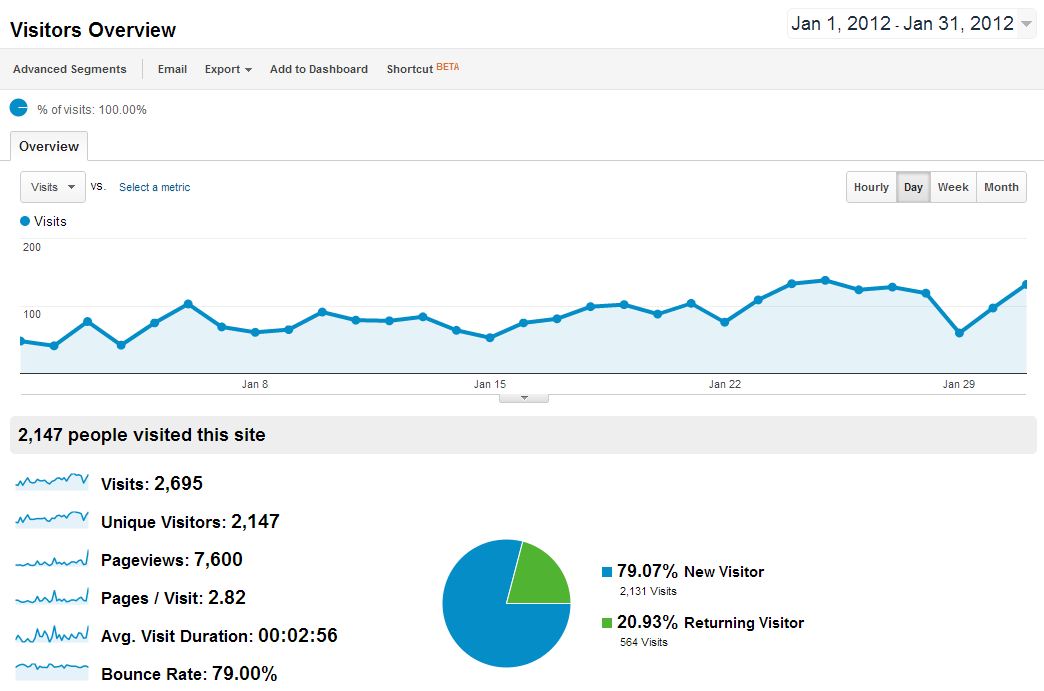
Traffic January 2012
Click to Enlarge
With zero promotion and no advertising, we had a decent first month, bringing in over 2,000 visitors. This was mostly due to our pre-launch strategy – which I’ll explain more later in this post.

Nine Months After Launch

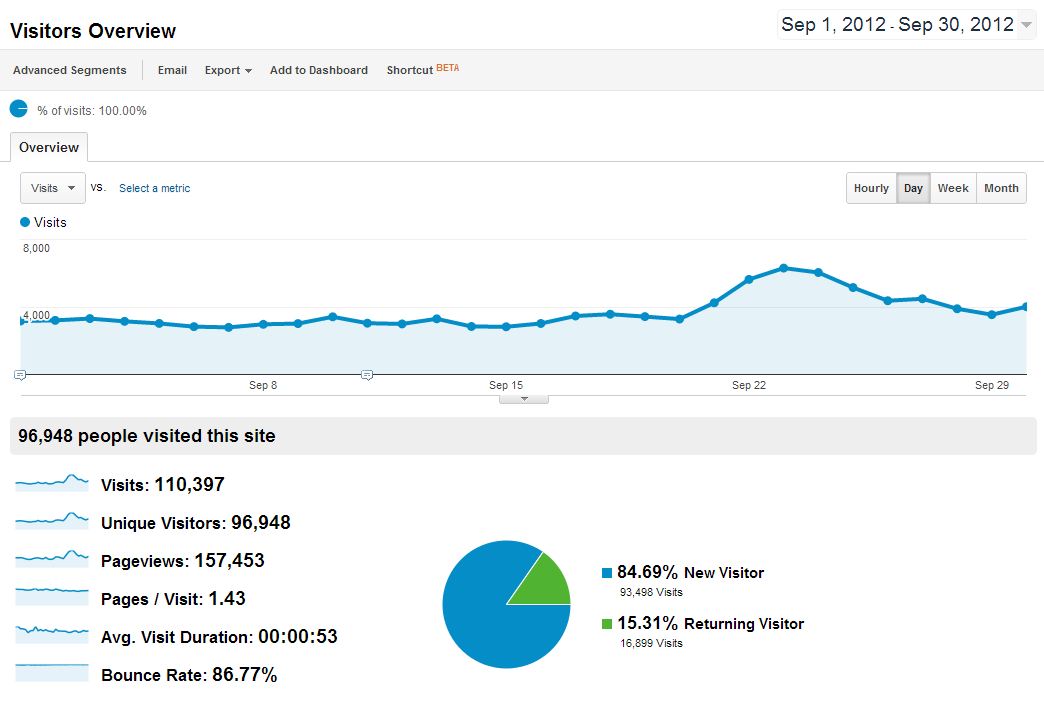
First Month 100000 Visits
Click to Enlarge
After only 9 months we were 3 months ahead of schedule to pass 100,000 visitors with no signs of slowing down.
Do you want to get traffic results like these for your website?
Get a free SEO quote for your website »

Traffic Sources

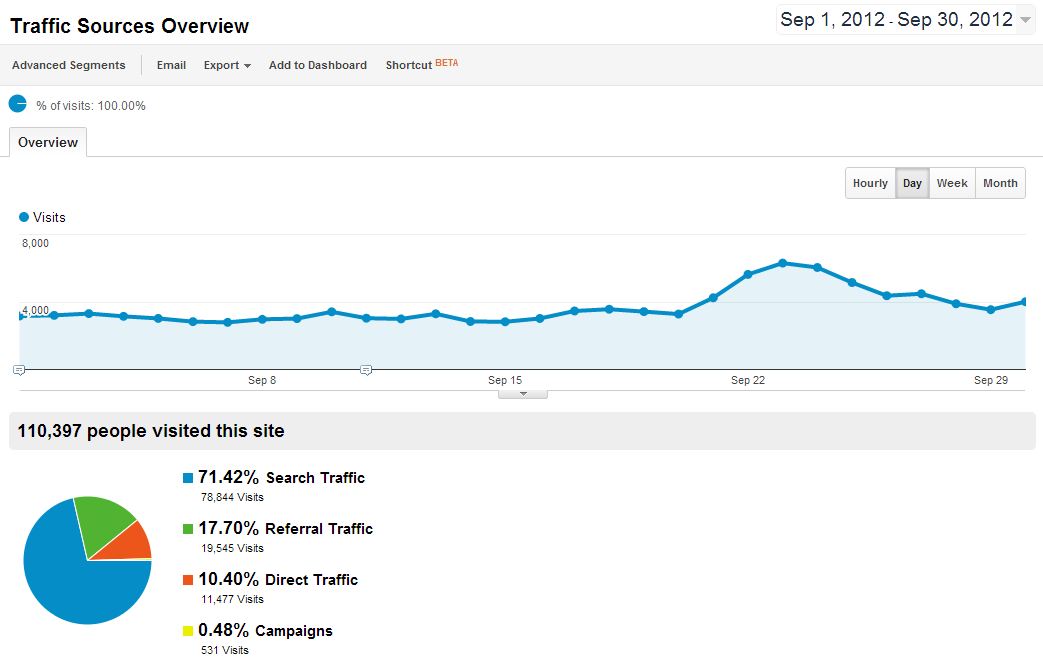
Traffic Sources September 2012
Click to Enlarge
As you can see in the screenshot above, organic search drives the most significant portion of our traffic. Referral traffic is almost entirely from blogs and industry publications, and campaigns is representative of the ads that we place, only on our website, to test different language and call to actions to drive conversions.

Building a Keyword Database

This is an obvious no-brainer for all SEO’s, however, unlike most search campaigns – this was a big keyword database, to the tune of 50,000 keywords.
The main idea here was leave no stone un-turned. Since we were of the mind to test everything and let the performance metrics dictate where to allocate resources, we had to get creative with query combinations.
We first went through all of our target search verticals, as dictated by our chosen go-to-market categories, which I think was roughly 19 to start. The next step was to identify the top 100 highest search volume terms within those verticals and scrape the top 100 URL’s that were currently ranking.
From here we began what started out as an exhaustive process of evaluating the opportunities for each keyword, and then aggregating opportunities to discern which categories we needed to focus on to grow traffic.
Essentially we targeted the low-hanging fruit; keywords identified by our model that could generate a minimum level of traffic  in 3 months or less, with a minimum investment in content development.
I watched (obsessively) which phrases and topics generated the most traffic.
As soon as a topic began to grow legs, we would focus additional keyword research on finding concepts and phrases that were both complimentary and contextually relevant.

Designing a Content Strategy

This is the single hardest part of any content-focused website or project.
The key to success on this particular project was taking a page out of Jeff Bezos’ book, and becoming obsessed with our customers.
We not only embarked on an aggressive a/b testing schedule, but we constantly reached out to our users for feedback.
We asked tough questions, ranging from what users’ liked and disliked (colors, fonts, and layouts) but also the specific components of the website they found to be less than ideal or even ‘sub-par.’
We took the responses seriously, making changes as they came in, trying to take something constructive from every piece of feedback, and pushing as many as 10 deployments a week.
It started to work.
Once we saw the needle begin to move on our user engagement metrics; time on site, pages per visit, and direct or branded traffic, we moved onto the next phase of our strategy; analyzing our audience.
Targeting the right audience is so much harder than it sounds.
I can honestly say from the experience of working on this project it is almost never as it seems. We began with targeting a very large segment of users (remember that time I talked about a keyword database of over 50,000 keywords?) but after a few months it turned out our largest (and most active) users were finding us from only a handful of targeted categories.

Information Architecture with SEO in Mind

Please allow me to preface this by saying that I am bias; in my opinion the architecture of a website is critical to achieving SEO success.
My largest successful SEO projects have come due to a variety of factors, but tend to come down to 3 core components of architecture:
  • It’s Scalable
  • It’s Crawlable
  • It’s Tiered
Scalable architecture is an obvious one; you need a system that can grow as large as you want/need it to.
Crawlable is nothing new to anyone in SEO; this simply means that the structure of our pages allowed for all of the most important content to quickly and easily be crawled and indexed by search engine robots. It actually sounds easier than it is… ensuring that the content is rendered (code wise) in the most ideal format for robots to parse takes more consideration than just laying out your div’s to properly render your designs.
To do this properly you need to make sure all of your code is in the right place, and more so, check how each crawler sees your page.
Take every opportunity to DRY out your code as much as possible, remember modern code is designed to cascade for a reason.
Information tiering… is a concept I have long-time preached to anyone who has ever talked with me, at length, about SEO. It means that your URL architecture should be built in a way so authority flows upwards through your directories.
For example, if I wanted to build authority around a core concept, I would focus my domain on that concept. If I then wanted to build relevance around specific locations for that concept, I would structure my URL’s so that all relevant content for that location fed upwards to a location specific directory.
So let’s say I had an SEO consulting firm with locations in several cities across the U.S., I would design an architecture that would allow for location-specific information to feed upwards through my directories.
So something like NicksSEOFirm.com/Philadelphia/Specific-Location-Content. The specific location content could be the team, any value-add competencies, anything geo-specific that was relevant to operations at that location, flowing relational authority upwards to the parent directory of /Philadelphia/.
Link in sub-directories can feed authority to parent directories.
A perfect example of this is local sitelinks for popular categories; tertiary directories with the most links and content which cause their upstream sub-directories to receive authority translating into higher rankings and local sitelinks.
Local-Sitelinks
Click to Enlarge

Launch Before The Launch

The easiest way to ensure a successful product or website launch is to launch before you actually launch.
What I mean is to build your prospect list well in advance of pulling the trigger to go live.
John Doherty wrote a great post on ProBlogger that talks about the power of leveraging list-building pre-launch pages. By building a list of users before publishing your full website you are essentially guaranteeing traffic immediately upon launch.
Our pre-launch is how we were able to generate over 2,000 visitors within the first 30 days of taking the website live.
Since our platform is not built on WordPress we didn’t get to use any of the fancy plugins available, and instead created a basic one-page site that allowed visitors to convert the same way the full website would support, just on a much smaller scale.
The most important part of our pre-launch page was that it not only supported social sharing, but was able to track and aggregate shares to give active users more points; gamification is cool.
Some of the major benefits of a well planned pre-launch are:
  • Your website is already being crawled and indexed by major search engines.
  • You begin building your user base and audience.
  • You can gain invaluable feedback while it’s still easy to make changes.

Choosing a Platform

Let me start by saying not all platforms are created equal.
It’s also worth sharing that it is not always better to build versus buy, as there are a lot of smart people building a lot of slick content platforms.
However, we chose to build.
Once we had laid out all of the project requirements, including URL architecture, conversion funnels, user permissioning, design templating, and localization, it became clear that in order to get exactly what we needed – we were going to have to build it ourselves.
One major benefit of building is we were able to design a system that would support both our internal and external processes right out of the gate. This also meant it was going to take a lot more time and a shitload more money to bring our website to market.

Hosting & Evolution

This is a known but rarely talked about factor – hosting infrastructure is critical.
Once we were ready for public launch we setup chose a reasonably affordable VPS provider with what seemed like more than enough memory, and it was at first.
By month 4 it was clear we were going to have to make some changes; load times began to bloat and large content pages were timing out. We beefed up the space and quadrupled the memory, which solved the problem temporarily until…
We got some press.
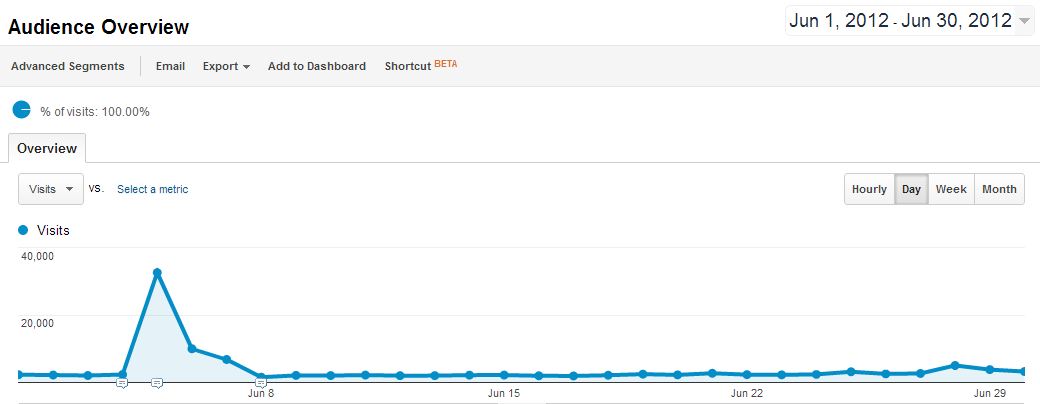
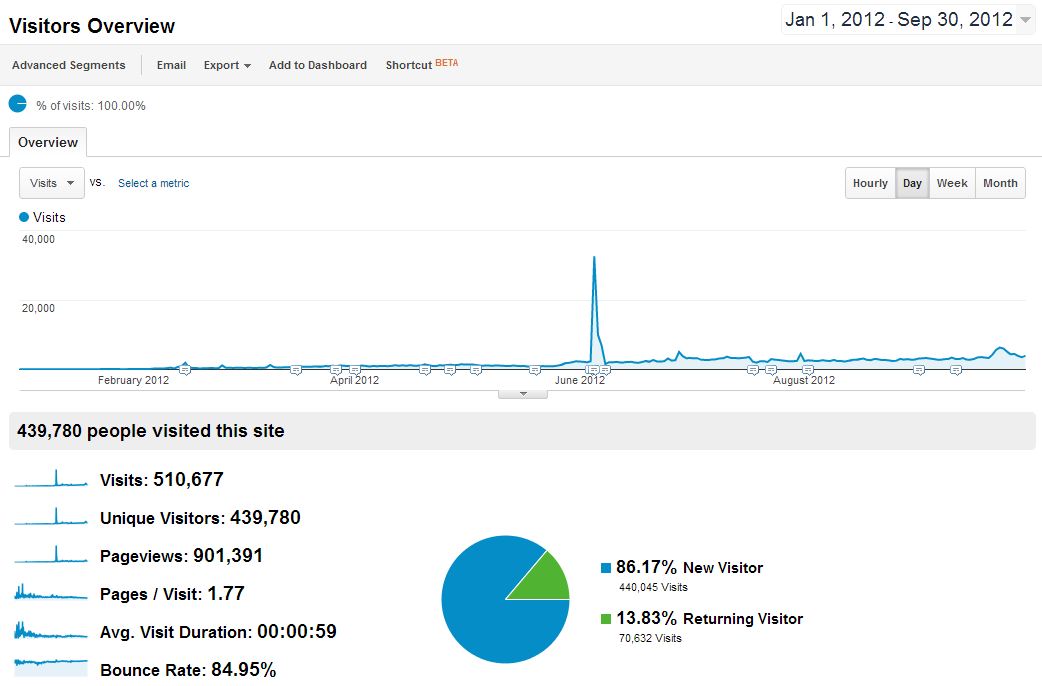
Traffic June 2012
Click to Enlarge
On June 5th we were featured by one of the largest news publications in the world. We were able to handle almost 40,000 visits before out VPS crashed, hard.
It was that week we made the move to localized cloud hosting from Amazon Web Services.
We haven’t crashed since.

The End Result

Not really the end result since this project is still enjoying a healthy and fruitful life, but after 9 months of careful planning, remaining flexible to the marketplace, and nurturing our most valued asset; our users, we surpassed our milestone of 100,000 visitors.
Search traffic from Jan 2012 to Sep 2012
Click to Enlarge

Great, But Is It Repeatable?

In case you weren’t already thinking it, you are now.
The answer is Yes.
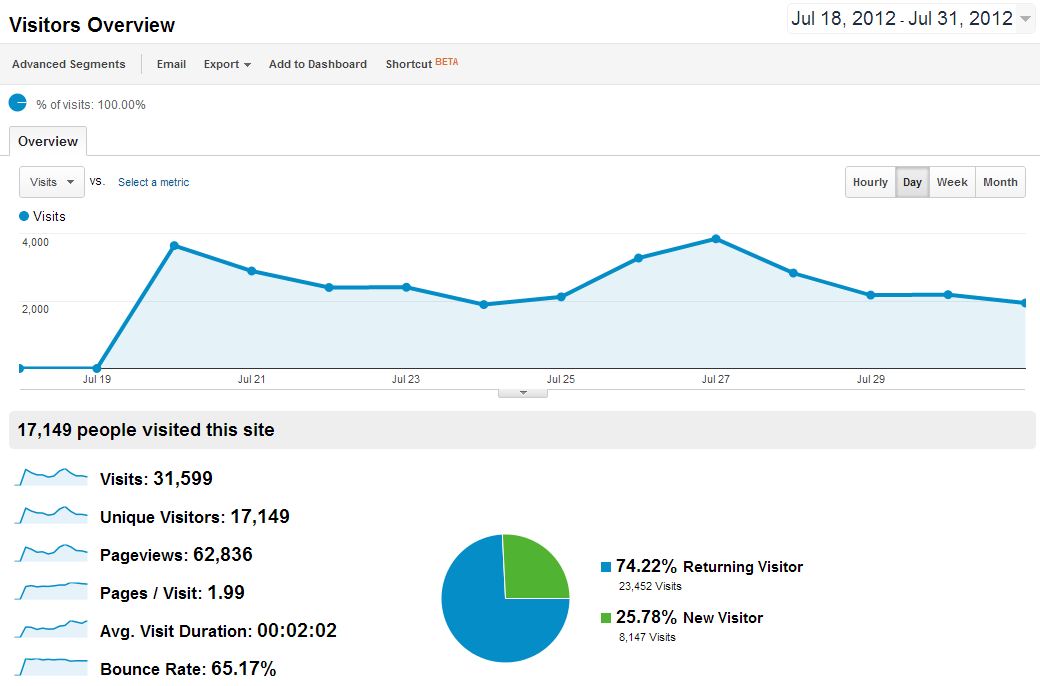
Taking what we learned and applying the concept of pumpkin hacking, we started a new blog at the end of July 2012 to test the transferability of our strategy, and here were the results:
Blog Traffic July 2012
Click to Enlarge
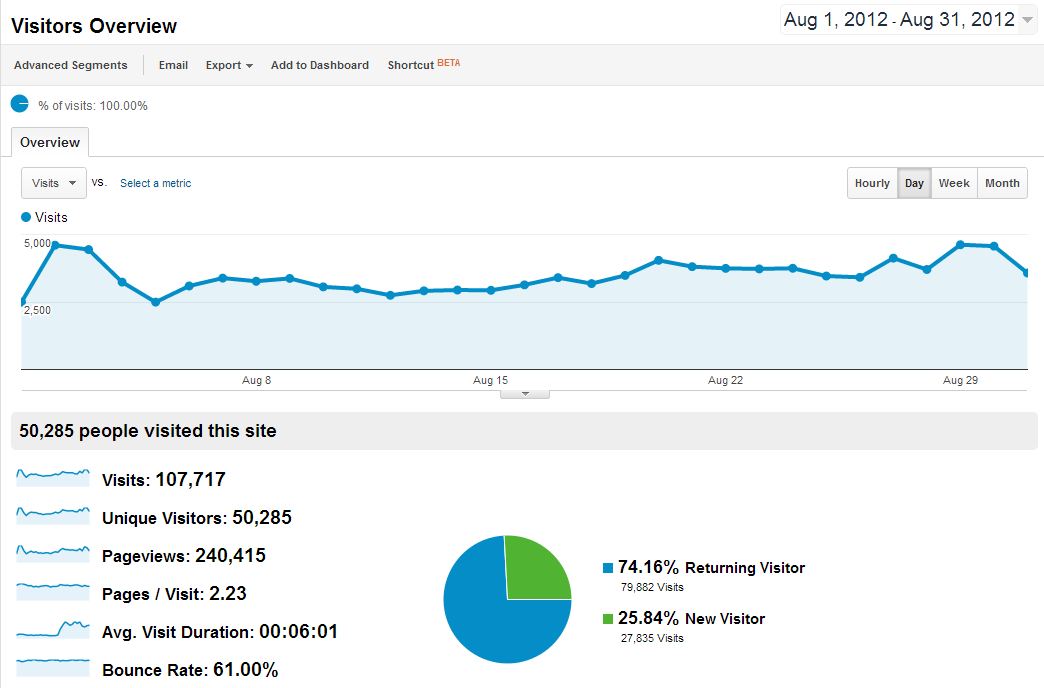
In the first 12 days we had over 17,000 visitors. In the first full month, we had over 50,000 unique visitors coming to the website over 100,000 times (see below).
Website Traffic August 2012
Click to Enlarge
And it didn’t slow down…
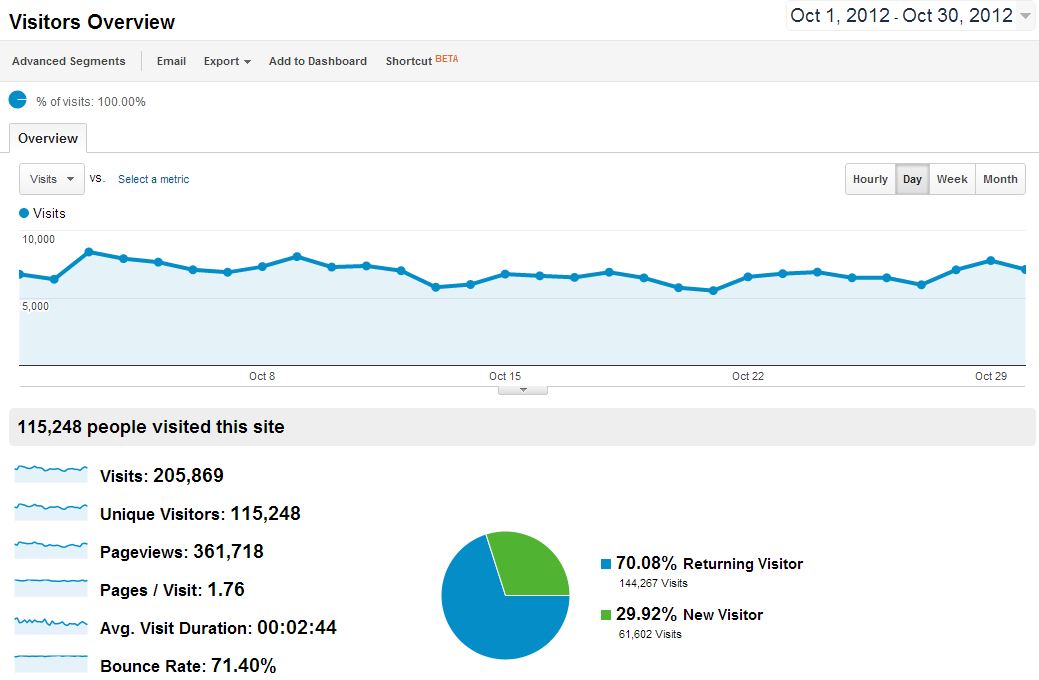
Blog Traffic October 2012
Click to Enlarge
By the end of the 3rd month we were receiving over 100,000 unique visitors, and over 200,000 visits.

Benchmark And Grow

One of the best ways to get started on your path to increasing your site’s organic traffic is to understand how much traffic potential is within your vertical, and to benchmark against it.
Start by looking at the top 5 sites that rank for the big head terms you’re targeting, and get a read on their traffic. To do this I like to use similarweb.com’s web traffic tool. It provides a good relative measure of a website’s traffic, sources, and some detailed data on where this traffic is coming from – and best of all, it’s free!

Conclusion

This is very possible.
You have to keep in mind though- this is not easy if you don’t have a specialized team by your side, that knows what they’re doing and when to adjust the strategy.
With careful planning, an SEO focused content strategy, and an understanding of the power of information architecture – you can grow a new website to over 100,000 organic visitors per month in less than 1 year.